
Grow West Newsletter
Growing Together Summer 2026

Beyond the Numbers
How WaterLabs is helping growers fine-tune irrigation decisions
Sutter County farmer John Amarel, of REASON Farms, had become frustrated with the irrigation technology, equipment and service he had been using for many years. He wanted irrigation technology that was reliable, cost effective, and easy to use and understand. He also wanted to incorporate pressure bombing and how it correlates to soil moisture monitoring.
The solution to his frustration was transitioning his almonds, walnuts and prunes to WaterLabs in 2025.
“Using WaterLabs, we are more comfortable and confident with our current irrigation decisions, regarding timing and amounts, because we know they are accurate,” Amarel said. “The moisture readings on the app are easier to understand. The pressure bomb readings along with the other readings means more data points we are able to go off of and be more specific about, and not overdo it. We know when to stress the trees and to what point. With our previous system, it was within a range and very vague.”
WaterLabs Tools at a Glance
Soil Moisture Probes
These provide precise measurements of percent soil moisture in the root zone. Data pulled from the probe shows when the irrigation system is turned on/off and how deep water infiltration has occurred.
Pressure Bombs
These help determine and monitor crop stress. Testing a leaf in the pressure chamber will help someone collect stem water potential data. Crop stress levels collected from the pressure chamber will determine how the crop responds to that level of stress.
Data
Calibrating soil moisture probes to pressure bomb readings allows growers to estimate when and how long to irrigate to prevent or encourage crop stress (specifically during hull split).
Data sets from the soil moisture probes and pressure bombs are
combined into an easy-to-understand summary report for growers that are accessible via computer, smart phone or tablet. For example, the graphs will show an average soil moisture line that matches stem water potential stresses. The reports help growers make the best decisions about efficiently irrigating their orchard or vineyard.
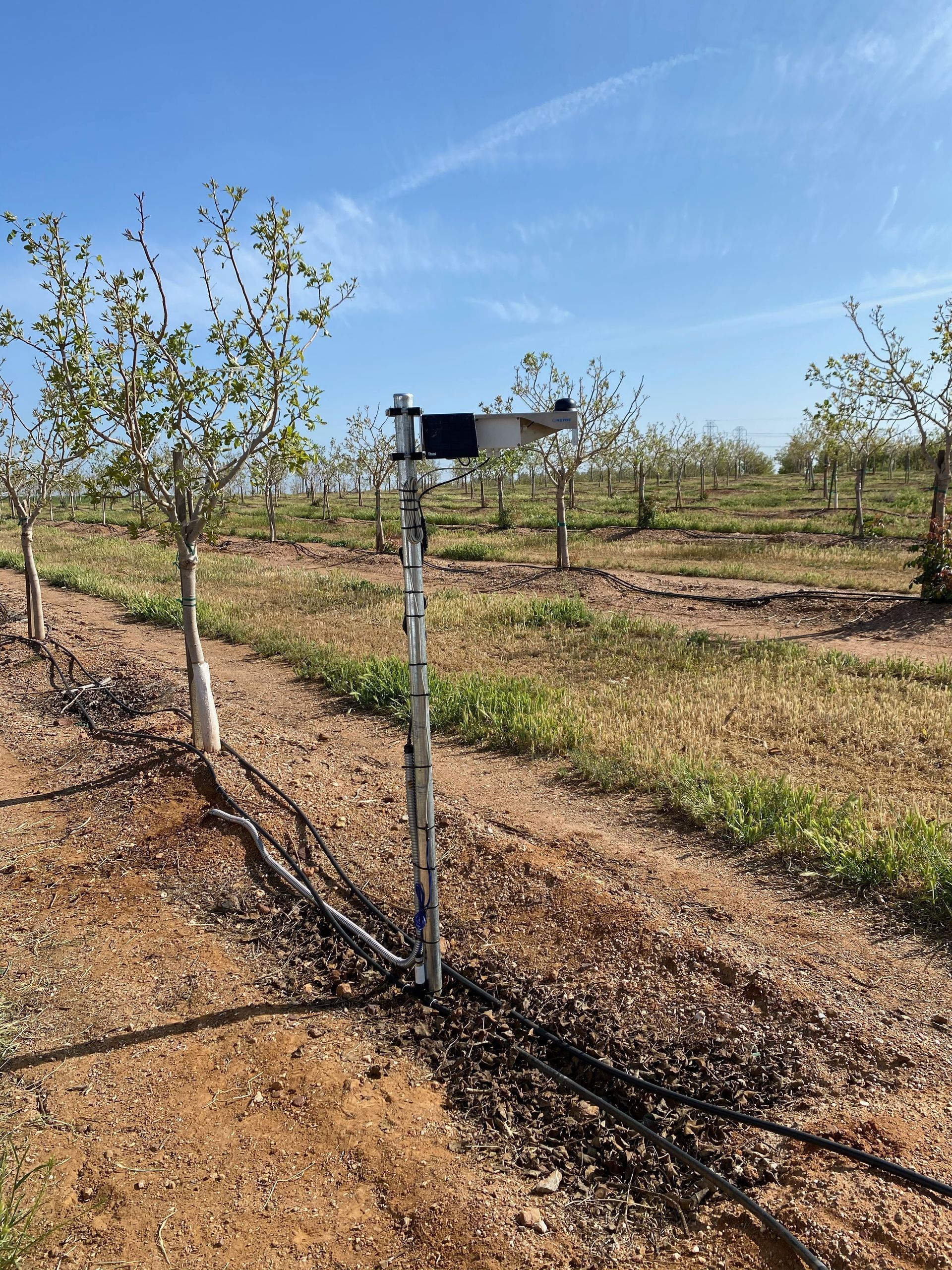
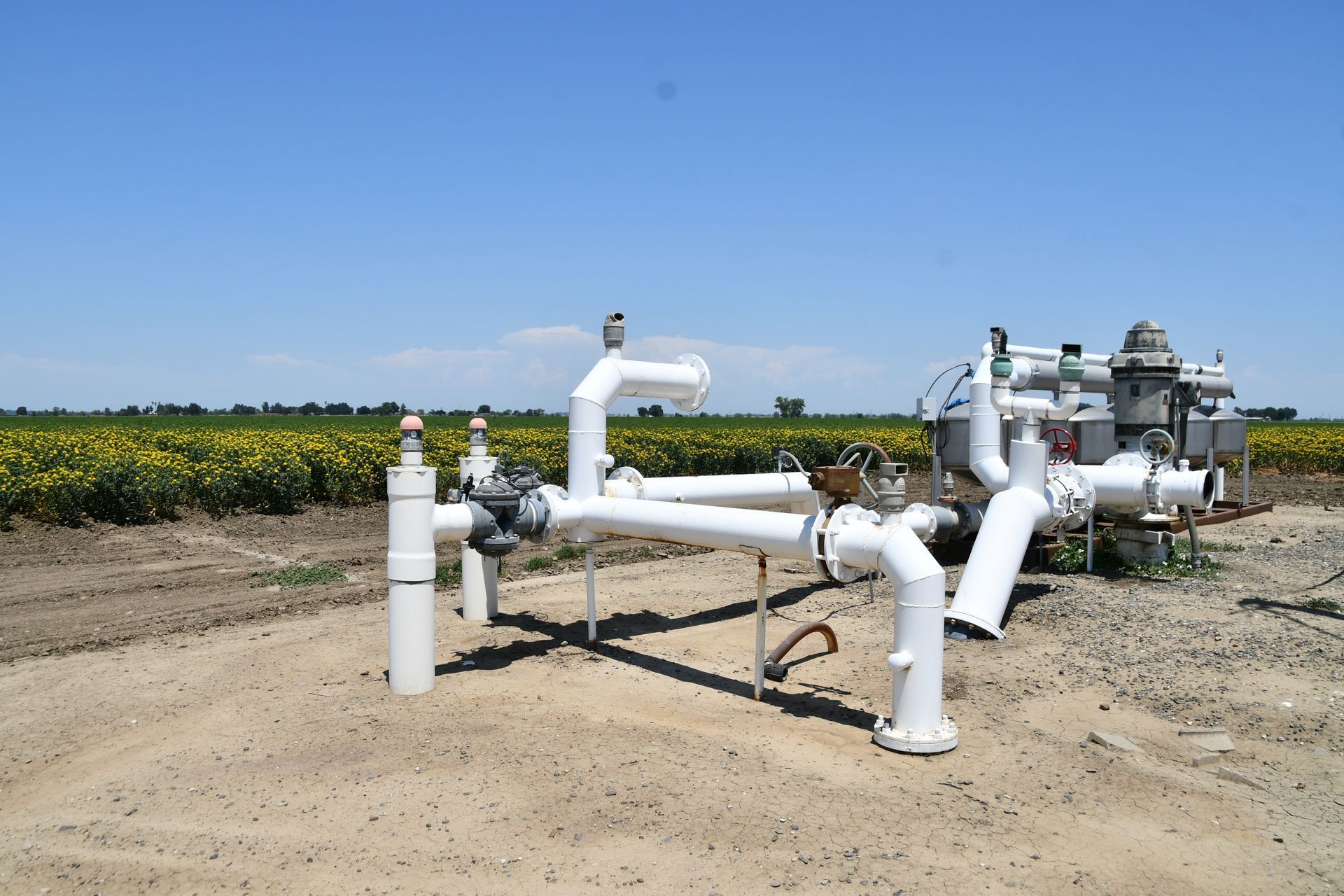
Soil moisture monitoring station.
Amarel said another positive feature of WaterLabs is the cost savings.
“We found we were under irrigating in some parts and over irrigating in other parts, so the cost savings is a big benefit,” he said.
Amarel is one of many Grow West customers who are increasingly using WaterLabs’ tools in their operations to guide irrigation decisions. By combining technology with on-the-ground experience, growers and Grow West PCAs are gaining more precise details about what’s happening below the surface – and using that information to make beneficial decisions throughout mthe season.
Grow West North Valley PCA Jake Onstott, who works out of the Yuba City branch, said Amarel continues to give excellent feedback about WaterLabs.
“They absolutely love our service,” Onstott said. “They continue to switch their old moisture systems over to WaterLabs. They have appreciated the ease of use and reliability.”
Onstott added that one of the lessons learned was trusting the technology.
“Sometimes it has given values/readings that seemingly don’t make sense, but when we went into the field and ground truthed and checked the info by hand in real time, we found that the WaterLabs readings are spot on,” Onstott said.
All About WaterLabs
WaterLabs Manager Rachael Wilson- Kelley, who oversees the day-to-day operation, said WaterLabs aims to provide growers with technology that saves them money and helps them avoid stress about irrigation decisions.
Pressure bombs (see boxed copy) are used to gauge crop stress and relate it to the soil moisture on an easy-to- read graph. WaterLabs doesn’t use algorithms or basic calculations; it uses in-field data that is site specific to each field. Accurate data from WaterLabs is key to irrigation management: timing, amount and duration.
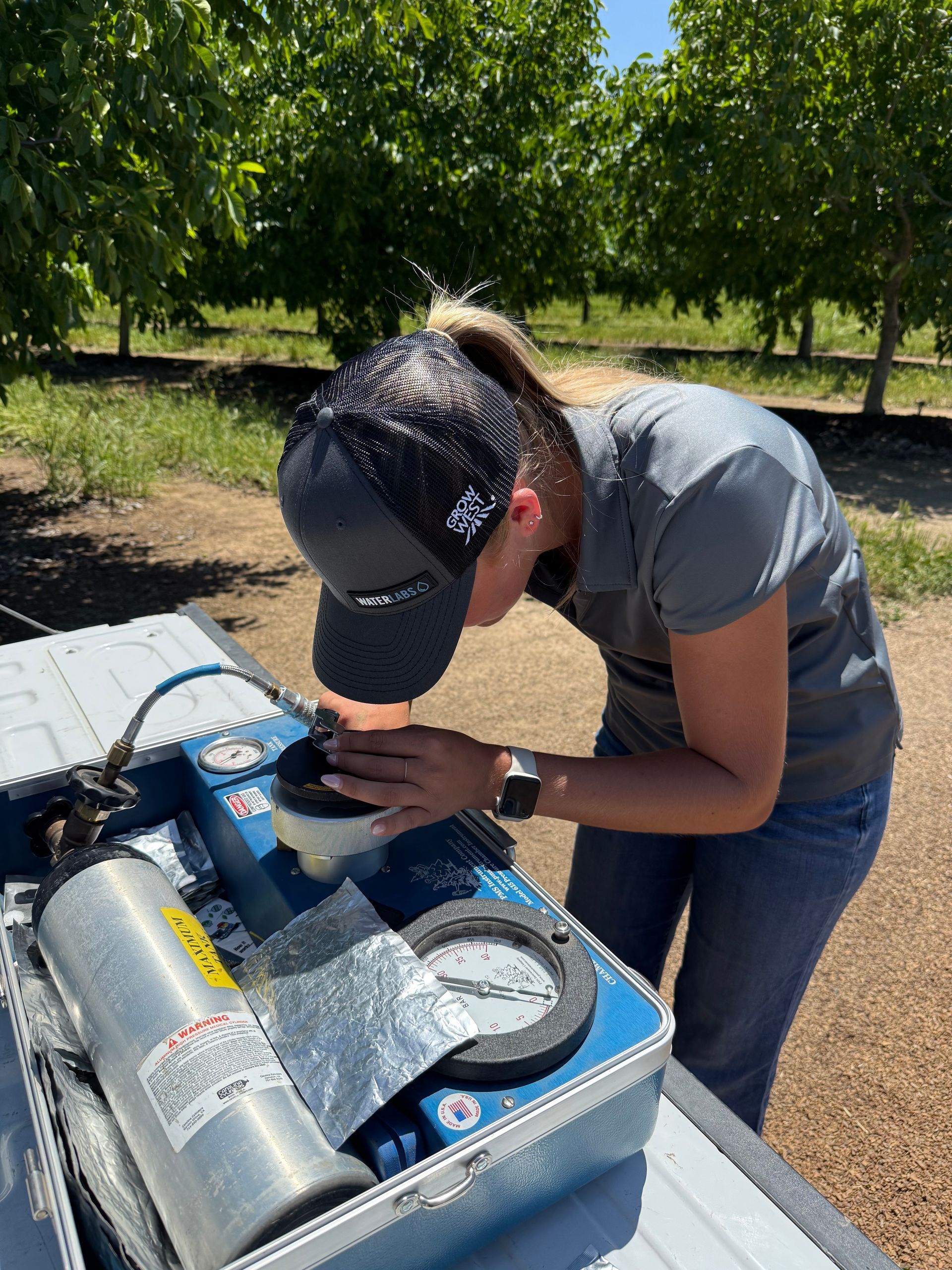
Intern Chasey Miller using the pressure chamber to determine stem water potential on walnuts.
“We’re busy all year, servicing stations to make sure they are up and running,” Wilson-Kelley said. “Winter is meetings with growers, trade shows and calls. We coordinate with growers where they want stations and get them out as soon as we can. Spring is busy with installs. During summer, we bring in interns, train them and send them on their own to service stations and pressure bomb orchards.
“We monitor stations and grower graphs continuously, making sure everything is working properly,” she said. “With the in-field data collection, we calibrate grower graphs to match the pressure bomb readings all the way up until post-harvest.”
'They Can Count On Us'
As with Amarel, Wilson-Kelley said feedback from growers has been positive.
“Growers say they enjoy using WaterLabs,” she said. “It really helps them irrigate in an easy way and they like the service aspect. They know they can count on us to be in the field when something looks wrong or broken.”
Amarel praised WaterLabs’ customer service. “We never have a problem getting a hold of anyone, especially Rachael,” he said. “She picks up every time there is a question and the question is answered. When an issue arose, she looked into it and it was handled quickly.”
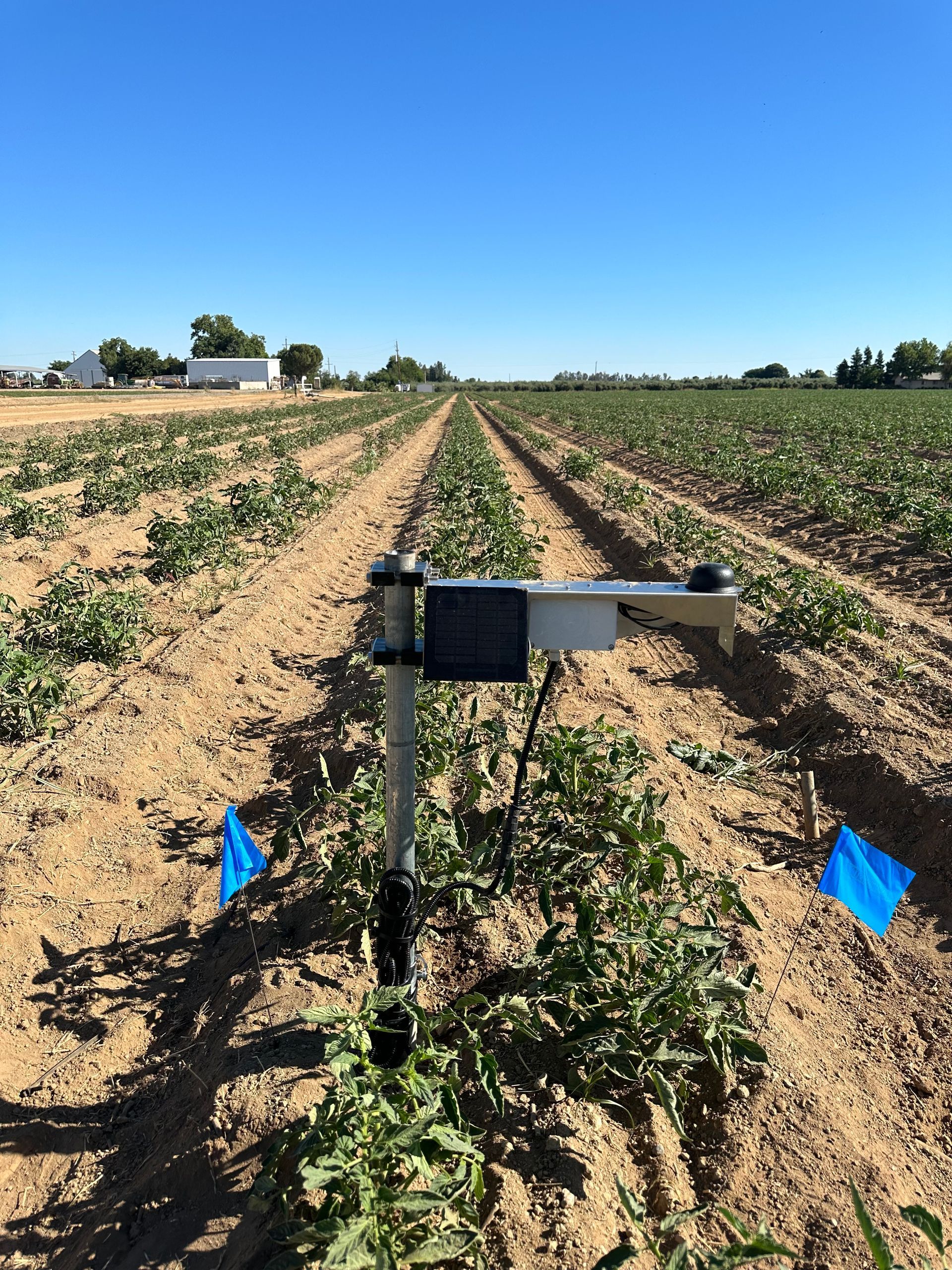
Soil moisture monitoring station.
Onstott added that the grower-Grow West PCA relationship is an extra benefit of WaterLabs.
“Many times during the season, we rely heavily on the intel to tell us how much to irrigate,” Onstott said. “If the grower gets off track or behind, I’m able to track it on the app and let them know we need to make some changes or decisions. And when growers see something that doesn’t make sense, they call me and I can help get things resolved. We’re able to manage the water to either help with nut fill during heat stress and also use slight stress leading up to almond harvest to bring on hull split and reduce hull rot.”
Issues on the Radar
Wilson-Kelley said one of the top issues she’s seen this year is under irrigation.
“Late spring rain made it seem like irrigations could be pushed further out, but warm temperatures dried up the soil quicker than some would think,” she said. “If you get behind early in the season, it is very hard to catch up.”
She also stressed that growers should deficit irrigate during hull split in almonds to prevent hull rot and alternaria.
“Over-irrigating and high humidity orchards can really hurt you during this critical time,” she said.
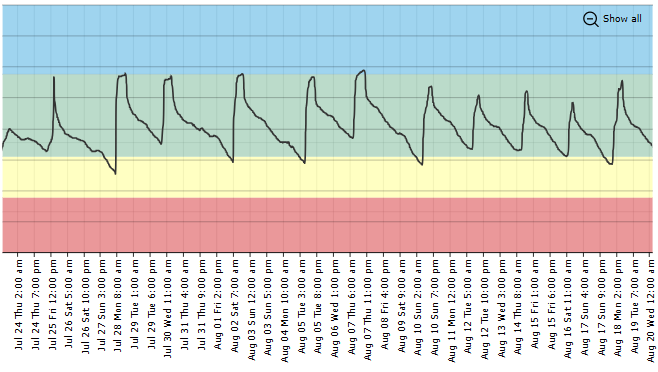
This graph is for non-bearing almonds. It is ideal to keep it in the green to promote and maximize shoot growth.
BLUE: Field capacity.
GREEN: Low to mild stress (promotes shoot growth).
YELLOW: Mild to moderate stress – shoot growth may slow, ideal for hull split in almonds.
RED: Moderate to high stress – likely to reduce yield potentials.
It is also important for growers to check irrigation systems early in the season for broken sprinklers, chewed hoses, plugged emitters and other issues where they will lack distribution uniformity.
“Checking sprinklers and running distribution uniformity (DU) tests on your fields will give you a greater chance of success for the growing season,” she said.
Expanding Crops and Services
To broaden its portfolio and attract new customers, WaterLabs is adding crops and services.
“We are heavily established in walnuts, almonds, prunes, pistachios and vineyards, but with more recent pressure bomb data, we have been able to expand into processing tomatoes and olives,” Wilson-Kelley said. “We have seen success with the correlation to the soil moisture probe and pressure bomb readings in these commodities. We are always looking to expand in crops where pressure bomb data is backed up by research.”
WaterLabs also provides disease modeling. Disease models use algorithms based on environmental parameters collected from weather stations linked to the biology and the life cycle of different diseases to predict development and progression in select crops. WaterLabs has utilized the models in almonds, walnuts, rice and onions. WaterLabs is looking to expand these offerings.
To learn more about how WaterLabs can benefit your operation, contact Rachael Wilson-Kelley at rwilson@growwest.com or 530-845-2150.