

Grow West Newsletter
Growing Together Fall 2020






Growing Together Fall 2020 - Being Tax Wise with Entity Selection
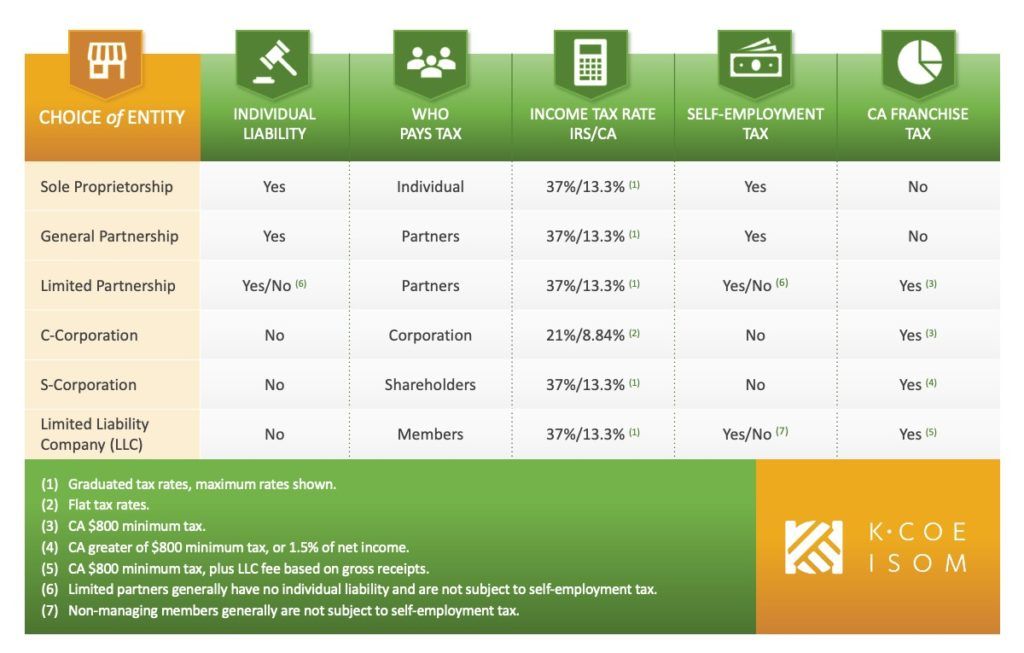
Business evolves. Environments change. Whether you’re a start-up business, or your situation has changed, evaluating the most advantageous entity structure for your unique business requires careful considerations and forethought. While there are many factors to consider when choosing the right business entity, the two primary factors we recommend starting with are: 1) whether the owner(s) desire personal liability protection and 2) who pays tax on the business income (and the rate of tax). Here is a high-level overview of the tax and liability differences between popular entity choices.
Sole Proprietorships – While not actually separate business entities, they are a very common form of doing business, particularly for small businesses.
- Taxes: An individual reports business income and expenses on personal income tax returns. Net income is taxed at the individual’s income tax rates, which are graduated based on the level of taxable income. They also pay federal self-employment tax on the business taxable income.
- Liability: There is no personal liability protection.
Article Written by Bill Peterson, K.COE ISON
General Partnerships – Two or more partners in the business, and the partnership files its own income tax returns.
- Taxes: The partners report their pro-rate share of partnership net income on their personal income tax returns, and pay tax on the partnership income at the same graduated tax rates as a sole proprietorship. Partners are subject to self-employment tax.
- Liability: Partners are jointly and separately liable for partnership liabilities.
Limited Partnerships – Under the two classes of partners, general partners are responsible for actively managing the partnership business, while limited partners are passive investors in the partnership.
- Taxes: General and limited partners report their pro-rata shares of partnership income on their personal tax returns; however, limited partners are not subject to self-employment tax, general partners are.
- Liability: General partners are jointly and severally liable, while limited partners’ liability is limited to their capital accounts.
C-Corporations – The entity pays its own taxes (set by state and federal tax rates). While double-taxation exists for C-Corps, reasons for consideration include: retaining profits for future growth, no limitations on types of shareholders, more than one class of shareholder, shares are easily transferable, and others.
- Taxes: Distributions or dividends to its shareholders are taxable to the shareholders; this situation creates double-taxation (the C-Corporation pays tax at its level, then any dividend from retained earnings is taxable again to the shareholders). C-Corporations shouldn’t hold assets that appreciate over time, like real estate, due to double-taxation.
- Liability: C-corporations provide liability protection to their shareholders.
S-Corporations – While there are some limitations, the tax structure generally eliminates double-taxation, and there is no self-employment tax payment for shareholders on S-Corp allocated income.
- Taxes: Shareholders report their pro-rata share of S-corporation net income on their individual tax returns, and pay tax at their applicable individual tax rates.
- Liability: S-corporations provide liability protection to their shareholders.
Limited Liability Companies (LLC) – LLCs offer flexibility and simplicity, as well as limited liability.
- Taxes: Members of an LLC separately report their pro-rata share of LLC net income on their individual tax returns, without the formality and structure of corporations. A LLC can have managing members charged with the active management of the LLC business and non-managing members, the significant tax difference is that managing members are subject to self-employment tax and non-managing members are not.
- Liability: As the name implies, LLCs provide liability protection to their members.
If you decide to form an entity, DOWNLOAD HERE a summary of the key filings and tasks required when beginning a new corporation or limited liability company in California.
Selecting the appropriate entity structure for your business involves many factors, and the tax pros and cons of each can vary greatly dependent upon the federal and state income and/or entity tax rates that are applied. For this reason, each unique business should seek legal and tax advice to minimize taxes and liability as much as possible.